
UV Curing
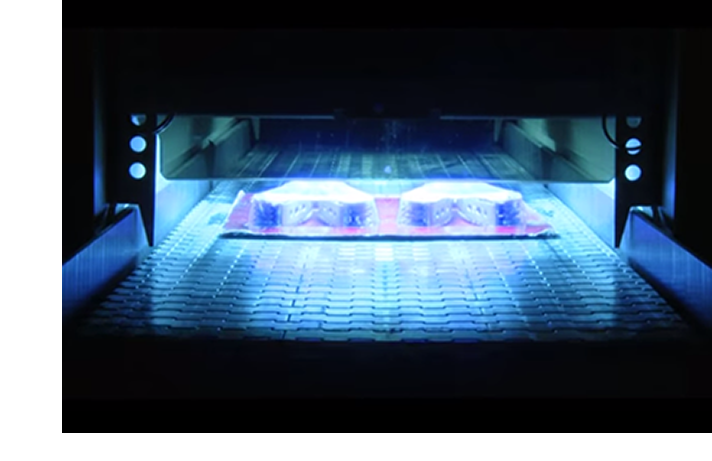
![]() Ultraviolet radiation can induce chemical and or physical changes in certain materials. This ability is used in many applications. These include hardening clear coatings on wood products, curing powdered coatings on metal products, activating adhesives and inks in the graphics industries and selectively etching circuitry in the electronics industry. Bottlenecks in production force development of new curing technologies
As the world’s population continues to expand, so too does the demand for goods and the world wants them fast and cheap. To keep up with the increase in demand, manufacturers are constantly looking to increase their output by shortening the production time while keeping costs low. One, typically troublesome bottle neck is the use of inks, paints, adhesives, and other coatings in production since these need time to set or cure properly. This may entail simply waiting the required amount of time for the product to set, which could take minutes or even hours, or attempting to accelerate the process with various methods such as forced air drying or oven baking. The gains in production experienced with these acceleration methods are often minimal and their adaptation and use typically costly. The pressure to free the bottleneck to increase their production and remain competitive in their markets would force manufacturers to research a faster, more adaptable, and less expensive alternative to traditional curing acceleration methods. The breakthrough in this research came in the form of new chemicals, called photoinitiators. These photoinitiators react when exposed to a certain amount of light from a particular band or “action” spectrum causing the compound containing the photoinitiator to cure by polymerization of the liquids within. Photoinitiators could be developed into a myriad of compounds useful in manufacturing, leading to the availability of instant or delayed cure photoreactive inks, paints, adhesives, and coatings. Designed with a wide selection of available action spectra, photoreactive compounds now give manufacturers a menu of solutions to quickly and economically adapt the technology to their unique applications. |
The right action spectrum is critical to production successChoice of action spectrum from a photoreactive compound will be dictated by the intended application for the product, the desired effects after curing, and even the manufacturing environment itself. Ultraviolet or UV light is typically used as the action spectrum due to the efficiency and economy with which it can be produced in a manufacturing process but also because manufacturing facilities tend to have large amounts of visible light present either from windows or task lighting. Accidental exposure to this visible light during production or storage could lead to costly premature curing if the photoreactive compound has an action spectrum similar to the visible light present. UV curing is not without its own set of considerations, however. Exposure to UV can gradually degrade production equipment and pose health risks to humans where visible light does not damage equipment and presents minimal harm and so may be the desired action spectra, particularly if a compound needs to be cured in direct contact with a person, such as with an oral adhesive. Specifically blue visible light is used in such applications as its shorter wavelengths are not produced in the large quantities from the sun or task lighting as are the longer visible wavelengths like green, yellow orange or red, allowing use without premature curing in normal lighting conditions and extending the working time beyond that of a photoreactive compound with an alternative visible light action spectrum. Blue visible photoreactive compounds will eventually cure if left exposed in a manufacturing or clinical environment and the curing process is typically less efficient and slower so UV curing remains the predominant choice in high-speed, large quantity production applications such as the printed circuit board, publishing, screen printing, and furniture manufacturing industries. |
ILT curing product cure problemsCuring a product with exposure to light, while fast and economical, requires careful control of the exposure process such as the spectral output of the light source, intensity levels, and exposure times of the products. As manufacturers ramp up their production, so too must the curing process be accurately adjusted and well maintained to ensure quality standards. International Light Technologies has developed a broad range of curing-specific instruments to aid in the challenging task of defining and monitoring these process variables. |
| Application | UV Sources Used to cure | IL Spectral Range | IL
Product Options Click Links Below |
IL Measurement Range | Units |
|---|---|---|---|---|---|
| 270-475 nm | ILT400BAV | 1 mJ to 20 J/cm² | W/cm² & J/cm² | ||
| 315-390 nm | ILT400UVA | 1 mJ to 20 J/cm² | W/cm² & J/cm² | ||
| 390-475 nm | ILT400UVV | 1 mJ to 20 J/cm² | W/cm² & J/cm² | ||
| 250-400 nm | ILT490 | 1 mJ to 20 J/cm² | W/cm² & J/cm² | ||
| Plastics | 250-400 nm | IL1700, SED005/WBS320/W | 2.33e-9 to 2.33e+0 W/cm² | W/cm² & J/cm² | |
| 250-400 nm | IL1400, SEL005/WBS320/TD | 1.82e-7 to 6.36e-1 W/cm² | W/cm² & J/cm² | ||
| Coatings | 330-340 nm | IL1700, SED005/NS335/W | 1.00e-8 to 1.00e+1 W/cm² | W/cm² & J/cm² | |
| 330-340 nm | IL1400, SEL005/NS335/TD | 2.33e-6 to 8.14e+0 W/cm² | W/cm² & J/cm² | ||
| Xenon Flash | 326-401 nm | IL1700, SED033/B/QNDS2/W | 5.70e-8 to 5.70e+1 W/cm² | W/cm² & J/cm² | |
| Low profile hi UV | 250-400 nm | IL1700, SED005/WBS320/RAMP18 | 8.00e-6 to 1.00e+1 W/cm² | W/cm² & J/cm² | |
| 250-400 nm | IL1400, SEL005/WBS320/RAMP18 | 4.00e-4 to 1.00e+1 W/cm² | W/cm² & J/cm² | ||
| Low profile low UV | 250-400 nm | IL1700, SSD001A | 2.22e-7 to 9.00e-1 W/cm² | W/cm² & J/cm² | |
| 250-400 nm | IL1400, SSL001A | 1.11e-5 to 9.00e-1 W/cm² | W/cm² & J/cm² | ||
| Low profile Spot-Cure | 320-400 nm | IL1700, XRD050 | 1.82e-7 to 1.82e+2 W/cm² | W/cm² & J/cm² | |
| Low profile Spot-Cure | 320-400 nm | IL1400, XRL050 | 9.09e-6 to 3.18e+1 W/cm² | W/cm² & J/cm² | |
| CURING | Dental curing | 370-515 nm | IL1700, SED033/TBLU/T1MM | 1.30e-7 to 1.29e+1 W/cm 2 | W/cm² & J/cm² |
| 370-515 nm | IL1400, SEL033/TBLU/T1MM | 6.45e-6 to 2.26e+1 W/cm 2 | W/cm² & J/cm² |


